
A software engineer resume needs to do three things well: pass automated ATS screening, surface your strongest technical skills within the first third of the page, and quantify impact in a way that non-technical hiring managers can still parse. These templates are built for exactly that.
Recommended templates
Modern
Clean sans-serif type with a left-aligned header and quietly bold section rules. Designed for engineers, designers, and PMs at startups.
Use this template → Best for engineering-led companiesMono
JetBrains Mono throughout, terminal-clean, opinionated. The resume that gets noticed at engineering-led companies and applied-research labs.
Use this template → Best for dense technical experienceCompact
Pure single column, standard section names, dense bullet spacing. Looks plain on purpose — lets your content do the talking.
Use this template →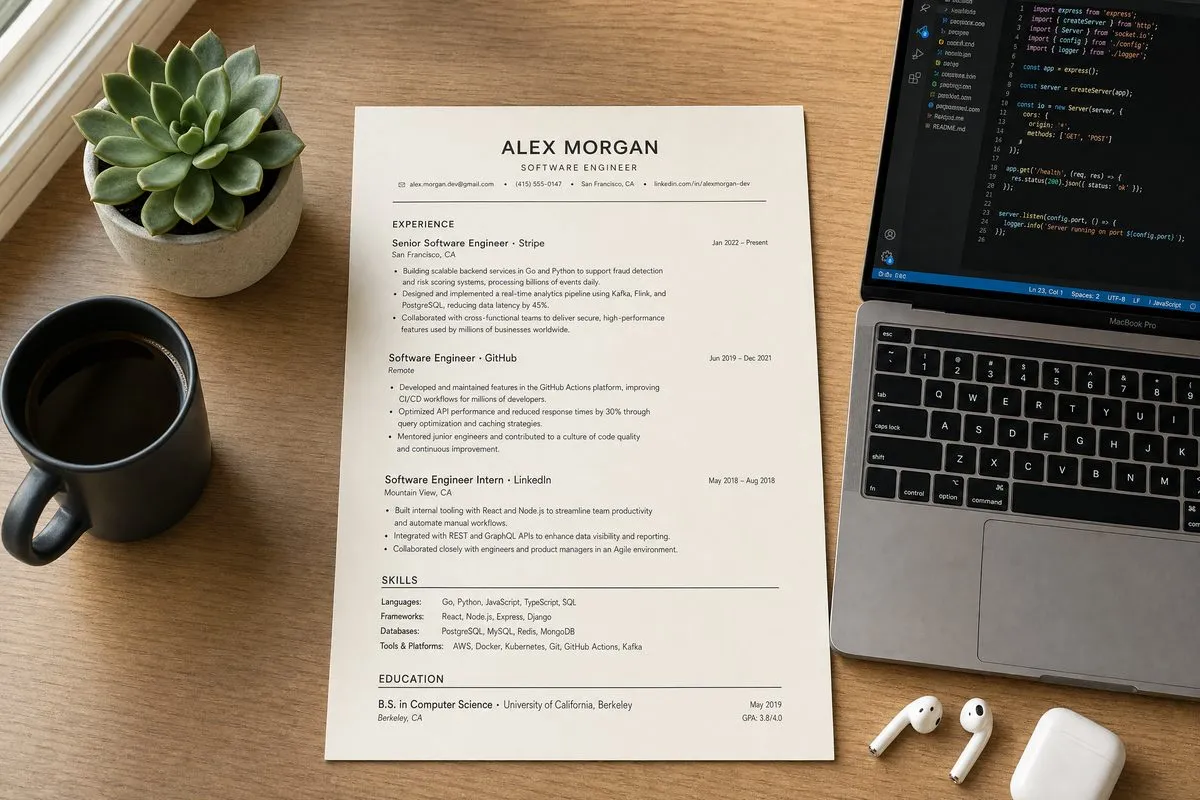
A clean, ATS-ready resume built with LuckyResume — ready to customize.
Try it free — pick a template and start writing
Start in seconds. Fill the form, export a clean one-page PDF. No watermarks, no paywall.
Open the editor →What engineering recruiters actually scan for
Engineering hiring managers spend an average of 7.4 seconds on the first pass of a resume. In that window, they are not reading your bullet points — they are scanning for pattern matches: company names they recognize, job titles that map to the role, and a skills section that confirms you speak the right stack.
The implication for template choice is clear: your resume needs a visual hierarchy that puts those three signals — employer, title, skills — in the spots the eye hits first. A left-aligned header with your name and current title, a skills section in the top third, and experience entries that lead with the company name in bold.
This is why "creative" resume templates fail for engineers. They scatter information across columns, bury skills in a sidebar, or use icons instead of text. The recruiter's eye has to work harder, and in a stack of 200 resumes, harder means skipped.
Print your resume. Hold it at arm's length. Can you identify your current employer and job title in under two seconds? If not, your template is fighting against you.
How to structure the skills section without keyword stuffing
The skills section on an engineering resume serves two audiences simultaneously: the ATS parser that needs exact keyword matches, and the human reader who needs to quickly assess your technical depth. Most candidates optimize for one and fail the other.
The ATS side is straightforward: list the exact terms from the job description. If the posting says "Kubernetes," write "Kubernetes" — not "K8s," not "container orchestration." Parsers are literal.
The human side is where template design matters. A flat comma-separated list of 30 technologies signals "I copied the job description." A categorized layout — Languages: Python, Go, TypeScript / Infrastructure: AWS, Terraform, Docker / Data: PostgreSQL, Redis, Kafka — signals someone who actually understands how these tools relate to each other.
Languages: Python, Go, TypeScript, SQL · Infrastructure: AWS (ECS, Lambda, S3), Terraform, Docker · Data: PostgreSQL, Redis, Kafka, dbt
Python, Go, TypeScript, SQL, AWS, ECS, Lambda, S3, Terraform, Docker, PostgreSQL, Redis, Kafka, dbt, Git, Linux, CI/CD, Agile, Scrum, REST, GraphQL, React, Node.js, MongoDB
Writing impact bullets that actually land
The single biggest differentiator between a mediocre engineering resume and a strong one is not the template — it's the bullets. Specifically, whether they follow the Action → Context → Result pattern or devolve into responsibility lists.
"Responsible for backend services" tells the reader nothing. "Redesigned the payment processing pipeline (Go, Kafka), reducing p95 latency from 1.2s to 340ms and eliminating $180K/year in third-party API costs" tells a complete story: what you did, how you did it, and why it mattered.
The template's role here is typographic: the bullet point, the indentation, and the line spacing need to give numbers room to breathe. When "40%" or "$2.3M" appears in a bullet, it should be visually distinct — not lost in a wall of uniform text. Our templates use slightly wider line height (1.45) in the experience section specifically for this reason.
Redesigned the payment processing pipeline (Go, Kafka), reducing p95 latency from 1.2s to 340ms and eliminating $180K/year in third-party API costs.
Responsible for maintaining and improving backend services. Worked on payment processing and API integrations.
ATS formatting: what actually matters (and what doesn't)
There is an entire cottage industry built on ATS anxiety — "your resume is being rejected by robots!" — and most of it is wrong. Modern ATS platforms (Greenhouse, Lever, Ashby, Workday) can parse well-structured PDFs without issue. They don't reject resumes for using color, and they don't choke on two-column layouts the way 2015-era systems did.
What does cause parsing failures: text embedded inside images (common in Canva templates), non-standard section headings ("Where I've Shipped" instead of "Experience"), and PDFs exported as flattened images rather than selectable text.
Every LuckyResume template uses standard section headings, a single-column flow, and exports clean text-layer PDFs. You don't need to worry about ATS compatibility — it's handled at the template level so you can focus on content.
Ready to build your resume?
Pick a template, fill in your details, and export a clean PDF. Free, no account required.
Frequently asked questions
Which template is best for a software engineer?
Modern works for most engineers — clean sans-serif type, strong hierarchy, startup-friendly. If you're applying to engineering-led companies (Stripe, Cloudflare), try Mono for its terminal-clean aesthetic. Classic is the safe pick for enterprise roles.
Should a software engineer resume be one page?
Yes, unless you have 10+ years of experience. Recruiters spend roughly six seconds on the first pass. One sharp page with quantified impact beats two diluted ones.
Do I need a portfolio link on my resume?
If you have a strong GitHub profile or personal site, include it in the contact line. But don't let it replace concrete bullet points — recruiters rarely click links during initial screening.
Should I list every programming language I know?
No. List the 8-12 technologies most relevant to the role you're targeting. A focused skills section is more credible than a wall of 30 buzzwords. Tailor it per application.
How do I handle short job tenures on my resume?
If you were at a company for less than a year, include it if the work was meaningful. Omit it only if you have enough other experience to fill the page. Gaps are less suspicious than unexplained short stints.