
A product manager resume lives or dies on how well it communicates impact. Hiring managers want to see what you shipped, who you influenced, and what moved. These templates are structured to foreground outcomes over process — because nobody hires a PM for their meeting cadence.
Recommended templates
Classic
Serif headings, generous margins, a Harvard-business-school feel that ages well across industries and seniority levels.
Use this template → Best for tech companies & startupsModern
Clean sans-serif type with a left-aligned header and quietly bold section rules. Designed for engineers, designers, and PMs at startups.
Use this template → Best for senior PM / Director of ProductExecutive
For directors, VPs, and senior ICs. Confident typography, clear hierarchy between role and impact, the right pace for a 10+ year career.
Use this template →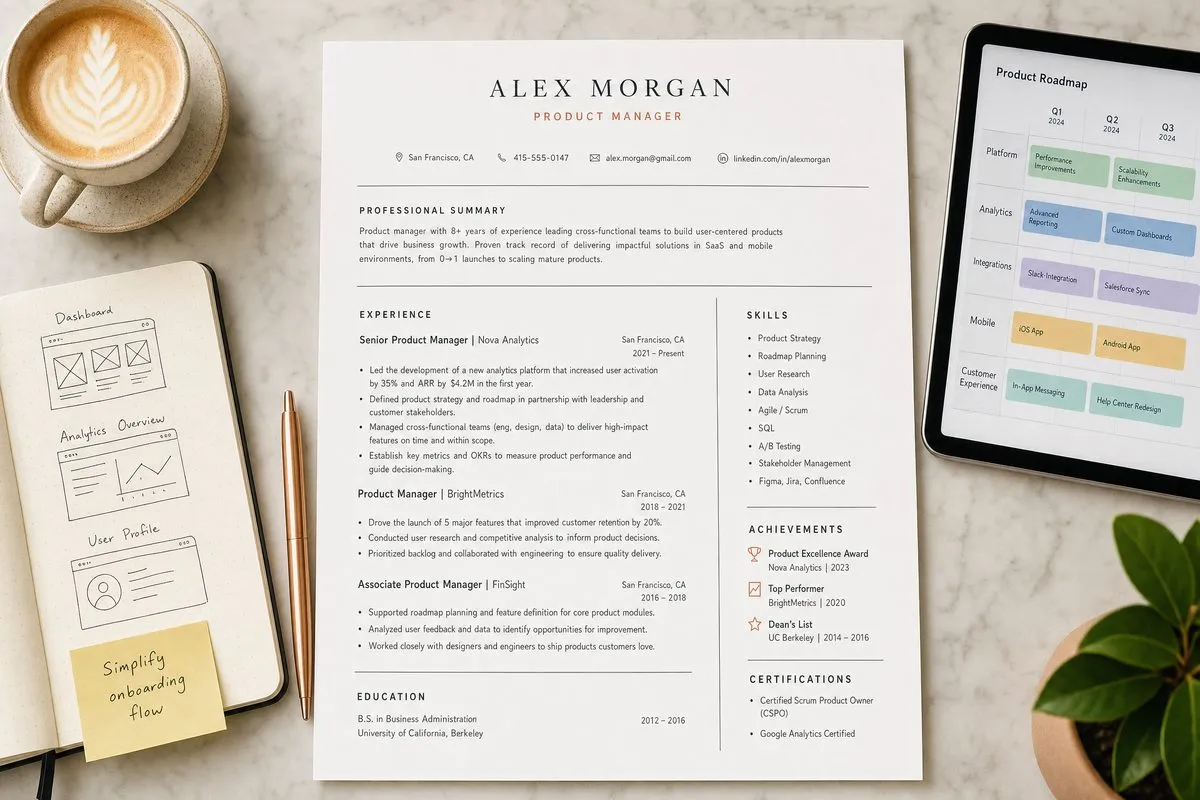
A clean, ATS-ready resume built with LuckyResume — ready to customize.
Try it free — pick a template and start writing
Start in seconds. Fill the form, export a clean one-page PDF. No watermarks, no paywall.
Open the editor →How a PM resume differs from an IC resume
An individual contributor's resume is about what they built. A product manager's resume is about what they decided and what happened because of those decisions. This is a fundamentally different narrative structure, and it requires a different template approach.
The experience section on a PM resume should lead with the outcome, not the activity. "Launched self-serve onboarding flow" is an activity. "Reduced time-to-value from 14 days to 3, increasing 30-day retention by 22%" is an outcome. The template needs to give that outcome line visual priority — which means the first line of each bullet should be the one that carries the number.
PMs also need more room for context than engineers do. A bullet that says "Led cross-functional team of 8 across engineering, design, and data science to ship a new pricing model" is long, but every word is load-bearing. The template's line spacing and bullet indentation need to accommodate this without the page looking cramped.
Which metrics actually impress PM hiring managers
Not all metrics are created equal. PM hiring managers have seen enough resumes to know the difference between a metric you owned and a metric you're borrowing from the company's press release.
Strong PM metrics are ones where you can explain the causal chain: you made a decision, it led to a change, and the change moved a number. Revenue impact, retention improvement, time-to-value reduction, conversion rate lifts — these are strong because they imply you understood the problem, chose a solution, and measured the result.
Weak PM metrics are team-level or company-level numbers you had no direct influence over: "Contributed to a product that generated $50M ARR." Unless you were the sole PM on that product, this reads as credit-taking. Better to say "Owned the pricing page redesign that increased plan upgrade rate from 3.2% to 5.1%."
Redesigned the onboarding flow, reducing time-to-first-value from 14 days to 3 and increasing 30-day retention by 22% (measured via cohort analysis, n=12K users).
Contributed to a product that grew from 10K to 500K users and generated $50M in annual recurring revenue.
The PM skills section: what to include and what to skip
The skills section on a PM resume is the most misused section on the page. Half of PM resumes list "Agile," "Scrum," "Jira," and "Stakeholder Management" as skills — which tells the reader absolutely nothing, because every PM does those things.
A useful PM skills section lists tools you actually use (SQL, Amplitude, Figma, Looker) and domain expertise (payments, marketplace dynamics, B2B SaaS, growth/PLG). These are the signals that help a recruiter pattern-match you to a role.
If you list "SQL" or "Python," be prepared to be tested on it. PMs who list technical skills they can't demonstrate in an interview lose credibility fast. Better to list fewer skills honestly than to pad the section.
If a skill appears on every PM resume, it's not differentiating. "Agile" and "cross-functional collaboration" are table stakes, not skills. Replace them with specific tools, frameworks, or domain knowledge.
Ready to build your resume?
Pick a template, fill in your details, and export a clean PDF. Free, no account required.
Frequently asked questions
Which template is best for a product manager?
Classic is the safe, universal pick — it works at Google, JPMorgan, and Series B startups. Modern is better if you're targeting tech-first companies. Executive is right if you're at the Director/VP level with 10+ years.
Should a PM resume include technical skills?
Only if they're relevant and real. Listing SQL, Figma, or Amplitude is fine if you actually use them. Don't list Python if you took one course — PMs get tested on this in interviews.
How do I quantify PM impact on a resume?
Use the formula: Verb + what you did + measurable result. Example: "Launched self-serve onboarding flow that reduced time-to-value from 14 days to 3, increasing 30-day retention by 22%."
Should I include a summary section as a PM?
At the senior level (8+ years), yes — a 2-3 line summary that frames your domain expertise and leadership scope is valuable. For APMs and early-career PMs, skip it and let your experience speak.
How many bullet points per job should a PM have?
3-5 bullets per role, each focused on a different shipped outcome. If you need more than 5, you're probably listing activities instead of results.