
An executive resume is fundamentally different from an IC resume. It needs a summary that tells a career story, experience entries that emphasize scope and organizational impact over individual tasks, and typography that conveys authority without shouting. These templates are built for exactly that shift.
Recommended templates
Executive
For directors, VPs, and senior ICs. Confident typography, clear hierarchy between role and impact, the right pace for a 10+ year career.
Use this template → Best for board-facing & traditional industriesClassic
Serif headings, generous margins, a Harvard-business-school feel that ages well across industries and seniority levels.
Use this template → Best for standing out with executive recruitersBanner
A subtle name banner on top, restrained body type below. The resume that recruiters remember after going through a stack of fifty.
Use this template →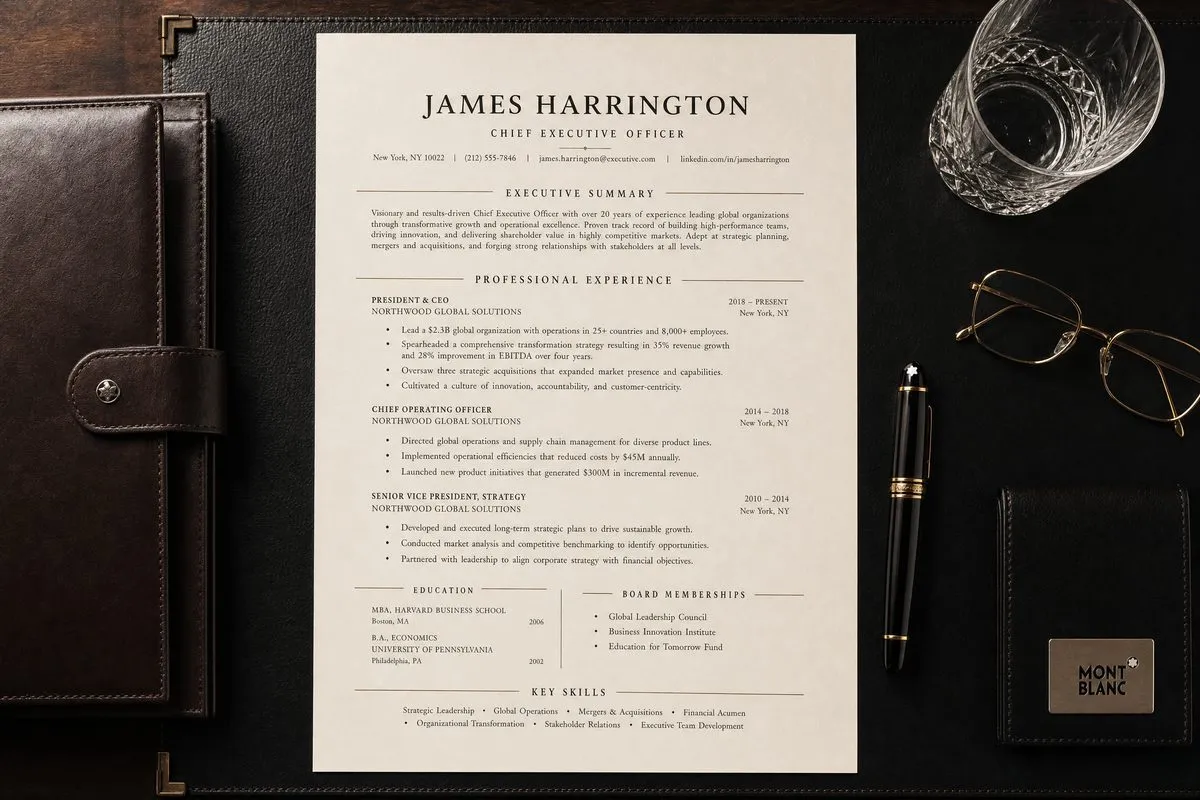
A clean, ATS-ready resume built with LuckyResume — ready to customize.
Try it free — pick a template and start writing
Start in seconds. Fill the form, export a clean one-page PDF. No watermarks, no paywall.
Open the editor →The executive summary: your career in four lines
At the IC level, a summary section is optional — your experience bullets do the talking. At the executive level, a summary is mandatory. It's the one section where you get to frame your entire career narrative before the reader dives into individual roles.
A strong executive summary does three things in 3-4 lines: names your domain ("B2B SaaS product leader"), quantifies your scope ("led organizations of 50-200 across three continents"), and states your trajectory ("from founding PM to VP of Product at a company that grew from Series A to IPO").
The template matters here because the summary needs visual prominence without overwhelming the page. Our Executive template uses a slightly larger type size for the summary (16px vs. 14px body) and a subtle left border that frames it as a distinct section. It reads as deliberate, not decorative.
[Domain expertise] leader with [X years] of experience [scope: team size, revenue, geography]. Track record of [2-3 signature achievements]. Currently [current role and what you're looking for].
Leading with scope, not tasks
The biggest mistake executives make on their resumes is writing experience bullets the same way they did as ICs. "Managed the engineering team" is a task. "Led a 120-person engineering organization across 4 offices, responsible for a $28M annual budget and the technical roadmap for a $200M ARR product line" is scope.
Each role entry on an executive resume should open with a scope line: team size, budget, revenue responsibility, geographic reach, and reporting structure. This is the information that executive recruiters and board members scan for first — it tells them whether you've operated at the level they need.
Below the scope line, 3-4 bullets should describe your most significant strategic initiatives and their outcomes. These should be organization-level achievements: "Restructured the engineering org from functional to product-aligned teams, reducing time-to-ship by 35%" — not individual contributions.
Resume length: when two pages is the right call
The "one-page resume" rule doesn't apply at the executive level. A VP or C-level candidate with 15-20 years of experience should use two pages — but only if every line earns its space.
The first page should contain your summary, your most recent 2-3 roles (with full scope and achievement bullets), and your skills/expertise section. The second page covers earlier career history (which can be condensed to 1-2 lines per role), board memberships, advisory roles, publications, and education.
Roles older than 15 years should be listed as one-liners: "Senior Product Manager, Acme Corp (2008-2012)." No bullets needed — the reader understands that your early career is context, not the main story.
Ready to build your resume?
Pick a template, fill in your details, and export a clean PDF. Free, no account required.
Frequently asked questions
Can an executive resume be two pages?
Yes. For VP and C-level roles with 15+ years of experience, a well-structured two-page resume is expected. But every line must earn its space — trim roles older than 15 years to one-liners.
Should I include a summary on an executive resume?
Absolutely. At the executive level, a 3-4 line summary that frames your career narrative, leadership philosophy, and domain expertise is expected. It's the one place where first-person voice is acceptable.
Which template is best for a VP of Engineering?
Executive is the natural fit — it has the gravitas and pacing for senior technical leadership. Classic works well if you're targeting more traditional companies or board-adjacent roles.
Should I list board memberships and advisory roles?
Yes, if they're relevant to the role you're targeting. Create a separate "Board & Advisory" section on page two. If you have more than 3-4, curate for relevance.
How do I handle a career change at the executive level?
Lead with a summary that bridges your old domain and new target. Emphasize transferable leadership skills (team building, P&L ownership, market strategy) over domain-specific expertise. The summary does the heavy lifting here.