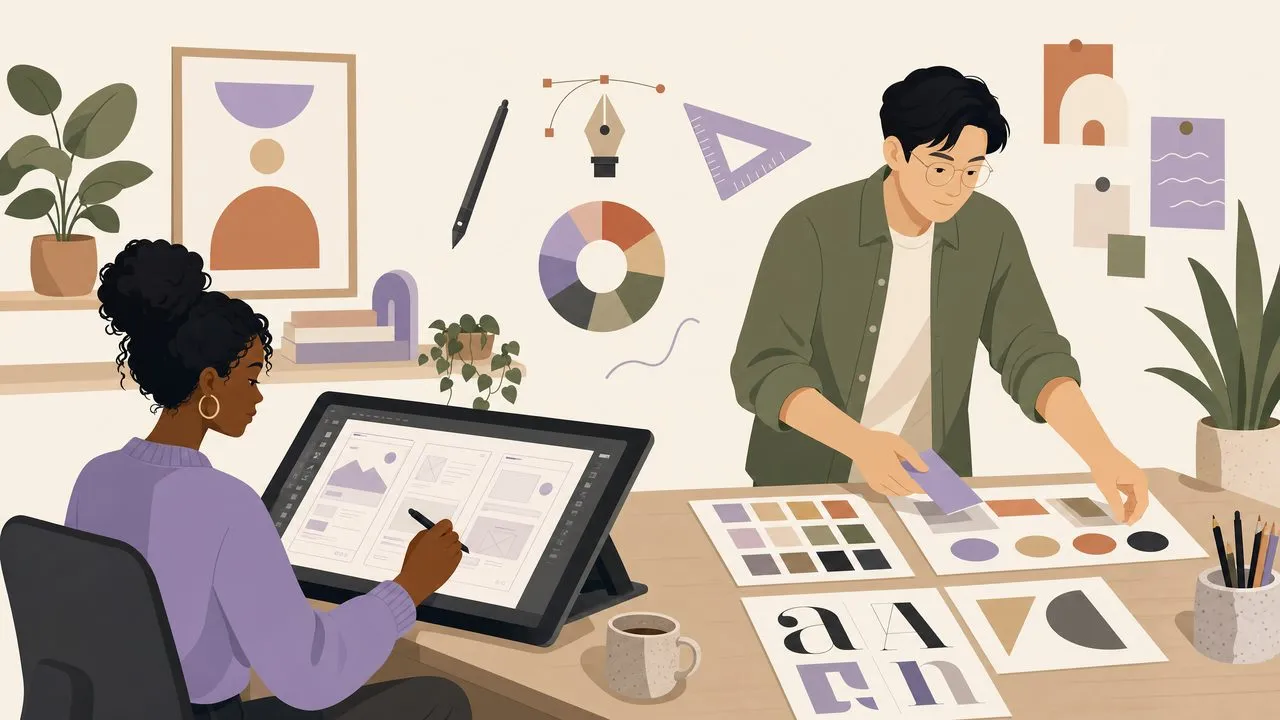
The best designer resumes are paradoxically understated. Hiring managers at design-led companies (Figma, Airbnb, Stripe) want to see that you can exercise restraint — that you understand hierarchy, whitespace, and information density. These templates demonstrate exactly that.
Recommended templates
Modernist
Generous whitespace, geometric sans, a hint of Swiss design. Lets a design portfolio do the talking.
Use this template → Best for brand & visual designersEditorial
Closer to a magazine spread than a Word doc. For longer-form CVs, academic applications, and roles where craft and writing matter.
Use this template → Best for standing out in a stackBanner
A subtle name banner on top, restrained body type below. The resume that recruiters remember after going through a stack of fifty.
Use this template →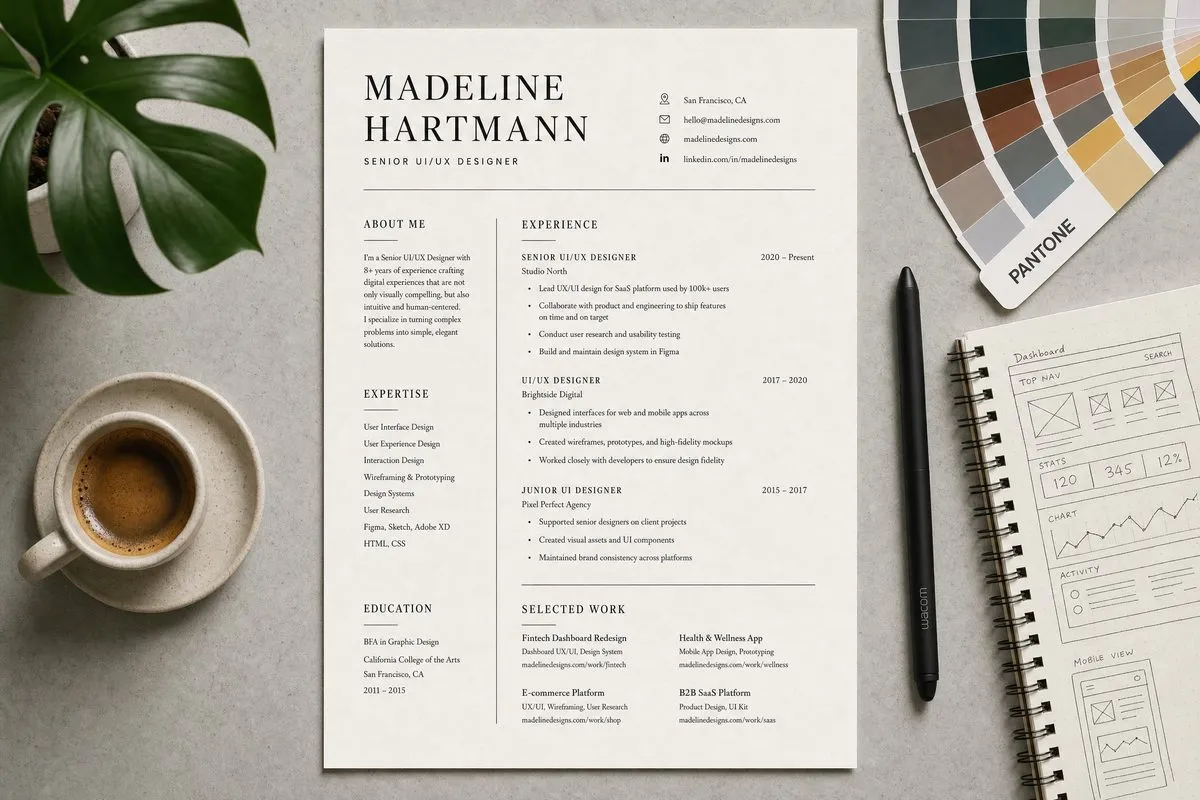
A clean, ATS-ready resume built with LuckyResume — ready to customize.
Try it free — pick a template and start writing
Start in seconds. Fill the form, export a clean one-page PDF. No watermarks, no paywall.
Open the editor →Your resume is not your portfolio — stop treating it like one
The most common mistake designer candidates make is turning their resume into a mini portfolio. They add color blocks, custom icons, infographic-style skill bars, and multi-column layouts. The result looks "designed" — and gets skipped by both ATS parsers and tired recruiters.
A resume and a portfolio serve fundamentally different purposes. The portfolio demonstrates your craft, your process, and your taste. The resume demonstrates your career trajectory, impact, and fit for a specific role. It's a business document, not a design artifact.
The best designer resumes signal design maturity through restraint: deliberate font pairing, generous whitespace, clear hierarchy, and zero decorative elements that don't serve the content. When a design hiring manager sees a clean, well-typeset resume, they think "this person understands the brief." When they see a Canva poster with skill bars, they think "this person doesn't know when to stop designing."
The resume tells me whether a designer can follow constraints. The portfolio tells me whether they can create. I need both signals, and I need them in separate documents.
How to quantify design impact on a resume
Designers often struggle with the "quantify your impact" advice because design outcomes are harder to isolate than engineering metrics. You didn't "increase revenue by 30%" — you redesigned a checkout flow that, along with engineering changes and a pricing experiment, contributed to a revenue increase.
The solution is to be honest about your scope while still connecting your work to outcomes. "Led the redesign of the checkout experience (3-month project, 2 engineers, 1 researcher), contributing to a 15% increase in conversion rate" is both honest and impressive. You're not claiming sole credit — you're showing that your design work was part of a measurable outcome.
If you don't have hard metrics, use proxy metrics: "Reduced support tickets related to account settings by 40% after redesigning the settings flow" or "Increased design system adoption from 60% to 95% across 4 product teams." These are real, measurable, and clearly within a designer's scope.
Led the redesign of the checkout experience (3-month project, cross-functional team of 5), contributing to a 15% increase in conversion rate and a 23% reduction in cart abandonment.
Redesigned the checkout page. Improved the user experience and made it more modern and user-friendly.
Where to place your portfolio link (and what to put in it)
Your portfolio URL should be in the contact/header area of your resume — same line as your email, phone, and LinkedIn. It should be a clean, clickable link: portfolio.yourname.com, not a shortened URL or a Google Drive link that requires access permission.
The portfolio itself should be curated, not comprehensive. Three to four case studies, each showing problem → process → outcome, is stronger than ten project thumbnails with no context. Design hiring managers spend 3-5 minutes on a portfolio during the initial screen — give them a clear path through your best work.
One more thing: make sure the portfolio loads fast and works on mobile. A surprising number of design portfolios are beautiful on desktop and broken on the phone the recruiter is using during their commute.
Ready to build your resume?
Pick a template, fill in your details, and export a clean PDF. Free, no account required.
Frequently asked questions
Should a designer resume be creative?
Confident, yes. Flashy, no. The resume's job is to get you to the portfolio review. A clean, well-typeset document signals more design maturity than a Canva poster with icons and color blocks.
Which template is best for UX designers?
Modernist — it has the Swiss-design sensibility that product design teams appreciate. Editorial works well for brand designers or roles where writing and visual storytelling intersect.
Do I need to include case studies on my resume?
No. Your resume should reference projects with measurable outcomes. Save the full case study for your portfolio. A one-line project description with a metric is more effective than a paragraph.
Should I use a PDF or a personal website as my resume?
PDF for applications through ATS. A personal website is great as a supplement, but most application systems require a file upload. Have both.
How do I show design tools on my resume?
List them in a skills section: Figma, Sketch, Protopie, Principle, etc. Don't use skill bars or percentage ratings — they're meaningless and take up space.