The example resume
Security engineering resumes face a paradox: your best work is invisible (nothing got breached). The strongest security resumes solve this by quantifying the defensive surface — vulnerabilities found and remediated, response times, compliance frameworks implemented, and attack surface reductions. The example below turns invisible defense into visible metrics that hiring managers can evaluate.
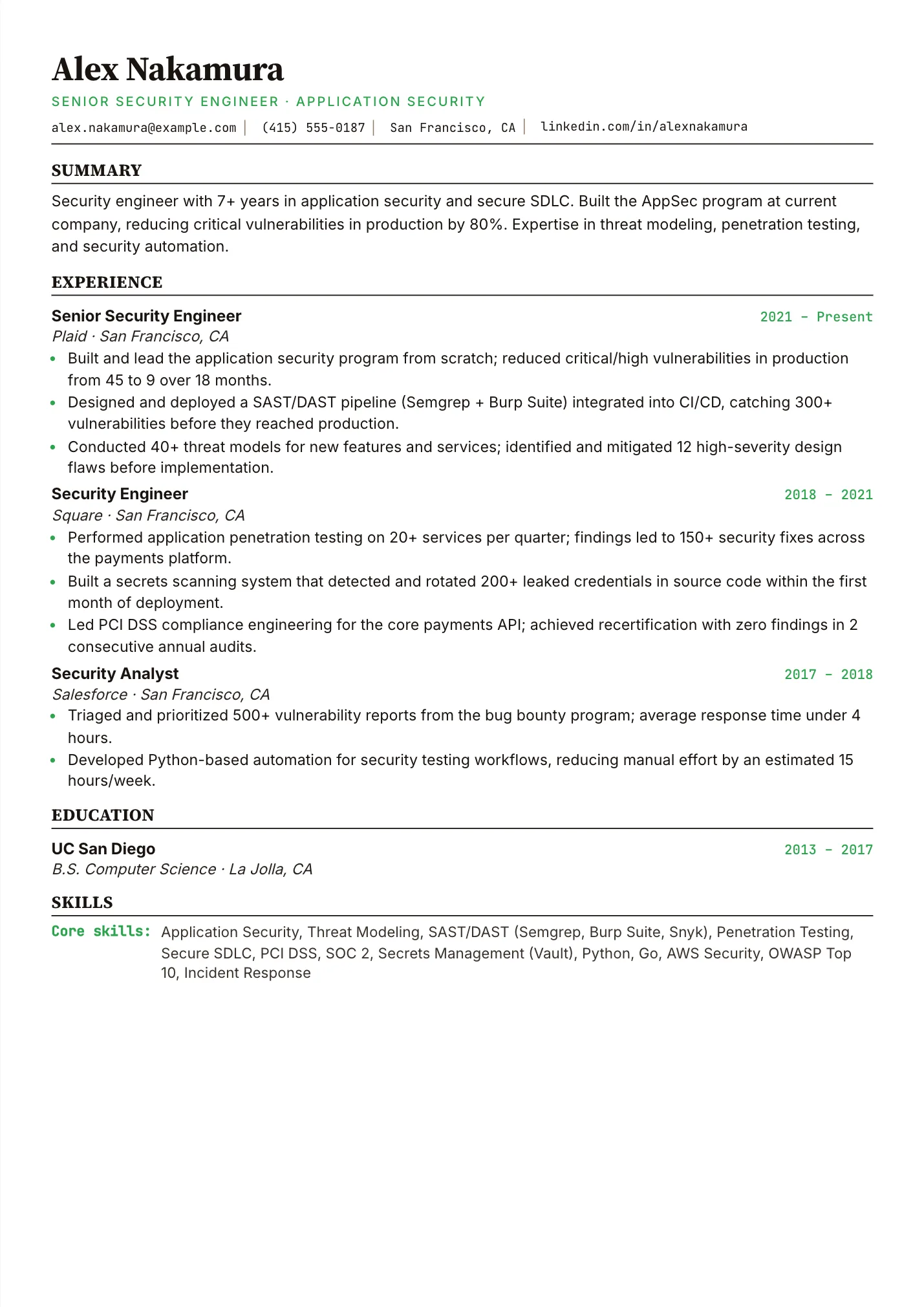
Security engineer with 7+ years in application security and secure SDLC. Built the AppSec program at current company, reducing critical vulnerabilities in production by 80%. Expertise in threat modeling, penetration testing, and security automation.
- Built and lead the application security program from scratch; reduced critical/high vulnerabilities in production from 45 to 9 over 18 months.
- Designed and deployed a SAST/DAST pipeline (Semgrep + Burp Suite) integrated into CI/CD, catching 300+ vulnerabilities before they reached production.
- Conducted 40+ threat models for new features and services; identified and mitigated 12 high-severity design flaws before implementation.
- Performed application penetration testing on 20+ services per quarter; findings led to 150+ security fixes across the payments platform.
- Built a secrets scanning system that detected and rotated 200+ leaked credentials in source code within the first month of deployment.
- Led PCI DSS compliance engineering for the core payments API; achieved recertification with zero findings in 2 consecutive annual audits.
- Triaged and prioritized 500+ vulnerability reports from the bug bounty program; average response time under 4 hours.
- Developed Python-based automation for security testing workflows, reducing manual effort by an estimated 15 hours/week.
Application Security, Threat Modeling, SAST/DAST (Semgrep, Burp Suite, Snyk), Penetration Testing, Secure SDLC, PCI DSS, SOC 2, Secrets Management (Vault), Python, Go, AWS Security, OWASP Top 10, Incident Response.
Build your security resume from this layout. Add your certs and incident metrics — clean PDF ready in minutes.
Use this template →Why this resume works
1. Vulnerability reduction is the headline.
Critical vulns from 45 to 9 (80% reduction). Security engineering is about reducing risk, and this single metric tells the entire story. Lead with your most impactful outcome.
2. Proactive security is quantified.
300+ vulnerabilities caught in CI/CD before production, 40+ threat models, 12 design flaws mitigated. These numbers show you prevent problems, not just find them after the fact.
3. Program building shows leadership.
Building an AppSec program from scratch signals you can own security strategy, not just execute tasks. This is what differentiates senior security engineers from analysts.
4. Compliance is included.
PCI DSS and SOC 2 with zero findings. For fintech and enterprise companies, compliance is a business requirement. Showing you can achieve it without friction is a major selling point.
Common mistakes for security engineer resumes
No vulnerability or risk metrics.
Security engineering is about reducing risk. If your resume does not include vulnerability counts, severity reductions, or SLA response times, hiring managers cannot assess your impact.
Only listing security tools.
"Experience with Burp Suite" is a tool mention. "SAST/DAST pipeline catching 300+ vulnerabilities pre-production" is a system. Show the program, not the tool.
Missing proactive work.
Threat models, secure design reviews, and security automation are proactive. If your resume only describes reactive work (incident response, pen testing), you look like you are always behind.
No compliance experience.
PCI DSS, SOC 2, ISO 27001, HIPAA — if you have compliance experience, list it. Many companies will not hire a security engineer without it.
Frequently asked questions
Should I list specific vulnerabilities I have found on my resume?
Describe categories and counts, not specific vulnerabilities. "Identified and remediated 200+ critical vulnerabilities through automated SAST/DAST pipelines" is appropriate. Never disclose specific exploits, CVEs you discovered in production, or details that could compromise a former employer.
How important are security certifications in 2026?
They remain important screening criteria. CISSP, OSCP, and AWS Security Specialty are the highest-signal certs. List them prominently — many recruiters use cert names as keyword filters, so omitting them can cost you ATS visibility even if your experience is strong.
How do I describe incident response on my resume?
Focus on your role, response time, and outcome: "Led incident response for a credential stuffing attack, containing the breach within 90 minutes and implementing rate-limiting that reduced attack surface by 95%." Avoid naming the attacker or disclosing sensitive breach details.
Free security engineer resume template
Security roles require a balance of certifications, tools, and incident response experience. LuckyResume’s template gives you room for a certifications row near the top (CISSP, OSCP, CEH) and keeps your experience bullets clean and metrics-dense. The PDF export preserves formatting through ATS systems used by security-conscious companies.
Secure the interview with a strong resume. Free, clean, ATS-ready. Quick sign-in.
Build yours →Security Engineer application toolkit
- Security Engineer cover letter example
- Security Engineer interview questions & answers
- Security Engineer resume skills & keywords