The MIT brand is global, but the resume still has to do the selling. The biggest mistake MIT students make is assuming the school name alone will carry them — and then listing every UROP, hackathon, and pset project without any hierarchy. The resume below, from a Course 6-3 (Computer Science and Engineering) senior, shows how to be selective and specific.
Resume tips for MIT Course 6 students
UROP is your secret weapon — frame it as real engineering.
MIT’s Undergraduate Research Opportunities Program is one of the most recognized undergrad research brands in the world. But writing “Conducted research under Professor X” wastes it. Describe the system you built, the dataset you created, or the experiment you ran — and name the outcome. A UROP that produced a workshop paper or a deployed tool belongs in your Experience section, not buried under Education.
Course numbers are a shorthand — but only for the right audience.
6.006, 6.031, 6.824 are instantly recognizable to MIT alumni in hiring positions and to recruiters at companies that actively recruit from MIT. For applications outside that bubble, add a parenthetical: “6.824 (Distributed Systems).” Do not make the recruiter guess.
HackMIT and hackathon wins need technical specifics.
A hackathon prize line on its own is noise. What makes it a resume bullet is the technical detail: the model you trained, the API you built, the latency you hit. “Won Best AI Hack at HackMIT” is a trophy. “Built a real-time object detection pipeline in 24 hours using YOLOv8 + FastAPI; won Best AI Hack at HackMIT 2025” is a resume bullet.
Do not undersell 6.031 and 6.824 projects.
6.031 (Software Construction) and 6.824 (Distributed Systems) produce some of the most rigorous undergraduate projects in any CS program. If you built a distributed key-value store or a concurrent text editor, those projects demonstrate skills that many working engineers do not have. Feature them prominently.
Example MIT Course 6 resume
This resume is from an MIT senior in Course 6-3 (Computer Science and Engineering) with a UROP in CSAIL, two industry internships, and a HackMIT project that turned into a side business.
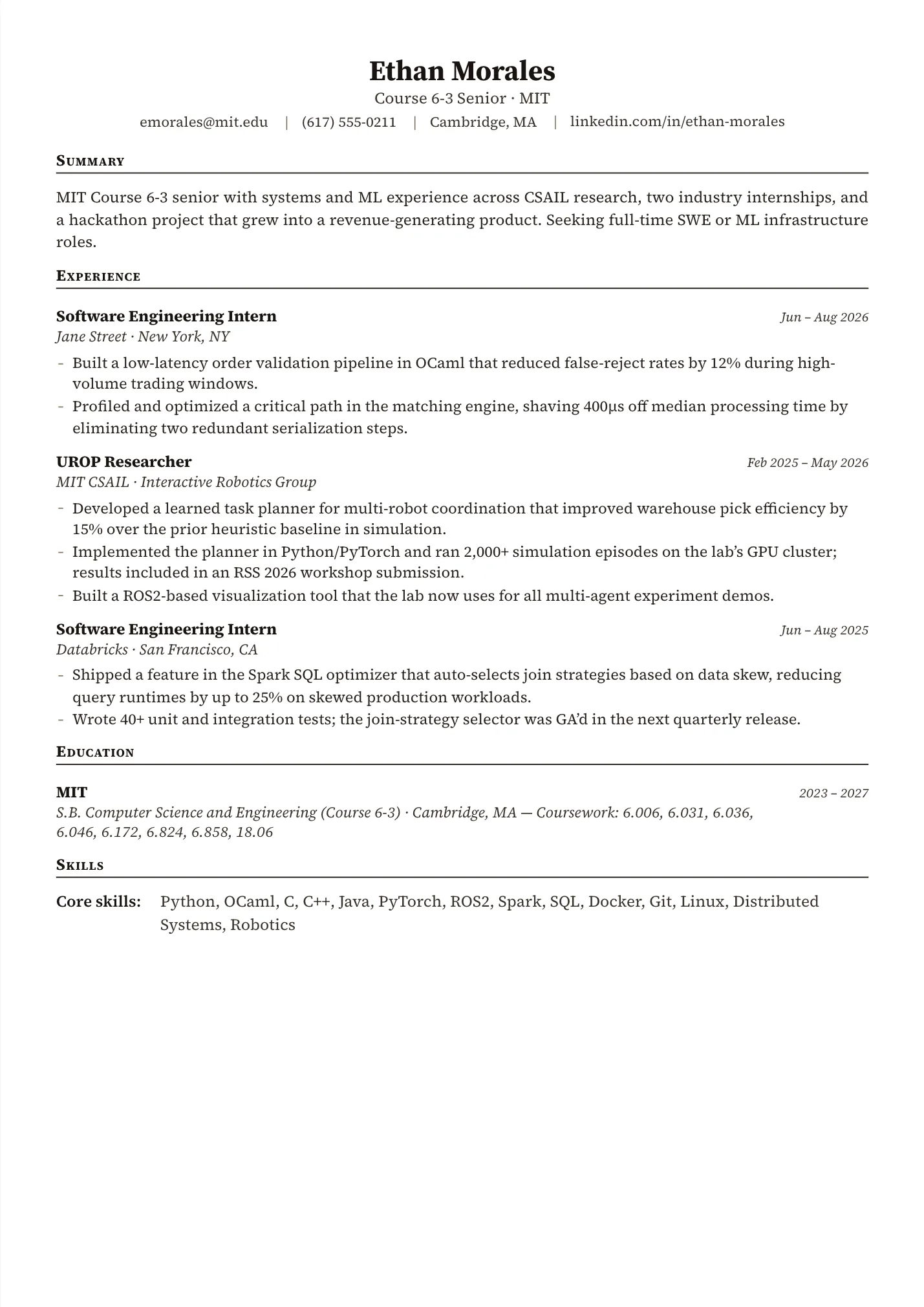
MIT Course 6-3 senior with systems and ML experience across CSAIL research, two industry internships, and a hackathon project that grew into a revenue-generating product. Seeking full-time SWE or ML infrastructure roles.
- Built a low-latency order validation pipeline in OCaml that reduced false-reject rates by 12% during high-volume trading windows.
- Profiled and optimized a critical path in the matching engine, shaving 400µs off median processing time by eliminating two redundant serialization steps.
- Developed a learned task planner for multi-robot coordination that improved warehouse pick efficiency by 15% over the prior heuristic baseline in simulation.
- Implemented the planner in Python/PyTorch and ran 2,000+ simulation episodes on the lab’s GPU cluster; results included in an RSS 2026 workshop submission.
- Built a ROS2-based visualization tool that the lab now uses for all multi-agent experiment demos.
- Shipped a feature in the Spark SQL optimizer that auto-selects join strategies based on data skew, reducing query runtimes by up to 25% on skewed production workloads.
- Wrote 40+ unit and integration tests; the join-strategy selector was GA’d in the next quarterly release.
6.824 Distributed KV Store — Implemented a sharded, fault-tolerant key-value store in Go with Raft consensus, shard migration, and linearizable reads; passed all 500+ test cases. HackMIT 2025 — Built a real-time lecture transcription tool (Whisper + GPT-4 summarization); won Best Education Hack, later grew to 800 monthly active users with $2K MRR.
Python, OCaml, C, C++, Java, PyTorch, ROS2, Spark, SQL, Docker, Git, Linux, Distributed Systems, Robotics.
MIT student? Build a resume that matches the rigor of your coursework.
Open the editor →What makes this MIT resume effective
1. UROP reads as professional research, not a homework extension.
A lab name (CSAIL Interactive Robotics Group), a quantified result (15% improvement), a publication (RSS workshop), and a tool the lab adopted. This entry proves the student contributed meaningfully — not that they attended meetings and read papers.
2. Industry experience spans quant and big data.
Jane Street and Databricks are very different technical environments. Showing success in both — low-latency OCaml at a trading firm and Spark optimization at a data platform — demonstrates adaptability and genuine systems breadth.
3. Hackathon project has post-hackathon traction.
800 MAU and $2K MRR turn a weekend hack into a product story. This is the strongest possible hackathon bullet because it shows follow-through, not just a 24-hour sprint.
4. Course projects demonstrate graduate-level rigor.
A sharded, fault-tolerant KV store with Raft is the kind of system most engineers only read about. Listing the specific features (shard migration, linearizable reads) and the test suite size proves deep understanding.
Frequently asked questions
Should I use MIT course numbers on my resume?
For companies that recruit heavily from MIT (Jane Street, Two Sigma, Google, Meta), yes — hiring managers there recognize 6.824 and 6.172 instantly. For all other companies, add a description in parentheses: “6.824 (Distributed Systems).”
How do I list a UROP on my resume?
Place it in your Experience section, not Education. Use the lab name as the company, “UROP Researcher” as your title, and write bullets the same way you would for an internship — what you built, what improved, and what the outcome was.
Do MIT students need a portfolio website?
It helps but is not required. A GitHub profile with pinned projects (especially your 6.824 or 6.031 work) does most of the same job. If you have a research paper or a hackathon project with traction, a simple one-page site linking to those artifacts is worth the hour it takes to build.
Free MIT resume template
Structured for Course 6 students applying to quant firms, FAANG, startups, and research labs. One page, ATS-compatible, and designed to showcase the kind of rigorous projects MIT is known for.
Stop tweaking LaTeX. This template exports a clean PDF in minutes. Same structure, zero formatting headaches.
Build your resume →