Apple’s engineering culture is defined by an obsession with user experience that extends all the way to the infrastructure layer. Apple engineers do not just make things work — they make things work beautifully, efficiently, and at the scale of a billion active devices. The resume below reflects this dual emphasis on craft and scale. Notice how performance optimization is framed as a user experience improvement, not just a technical achievement.
What Apple looks for in engineering candidates
Apple values depth over breadth. They prefer engineers who have gone extraordinarily deep on a small number of problems rather than those who have touched many things superficially. Your resume should demonstrate mastery: not "used Swift," but "optimized a Core Animation pipeline to hit 120fps on ProMotion displays." Apple also values discretion — you will not find Apple engineers tweeting about unreleased features, and your resume should reflect similar professionalism.
Resume example: Apple ICT4 software engineer
This resume targets an ICT4 (senior) position at Apple. The emphasis is on performance, user experience, and platform depth.
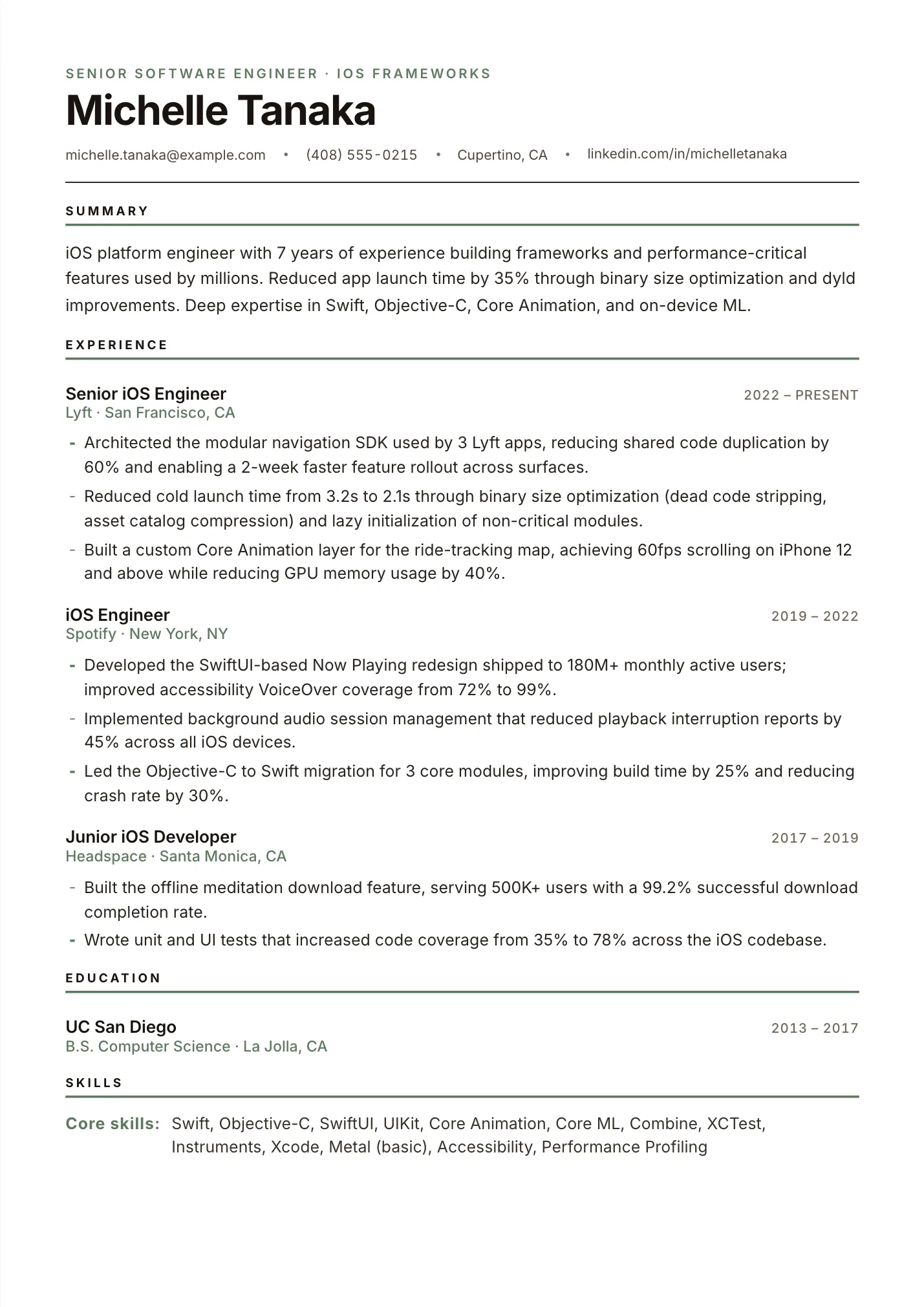
iOS platform engineer with 7 years of experience building frameworks and performance-critical features used by millions. Reduced app launch time by 35% through binary size optimization and dyld improvements. Deep expertise in Swift, Objective-C, Core Animation, and on-device ML.
- Architected the modular navigation SDK used by 3 Lyft apps, reducing shared code duplication by 60% and enabling a 2-week faster feature rollout across surfaces.
- Reduced cold launch time from 3.2s to 2.1s through binary size optimization (dead code stripping, asset catalog compression) and lazy initialization of non-critical modules.
- Built a custom Core Animation layer for the ride-tracking map, achieving 60fps scrolling on iPhone 12 and above while reducing GPU memory usage by 40%.
- Developed the SwiftUI-based Now Playing redesign shipped to 180M+ monthly active users; improved accessibility VoiceOver coverage from 72% to 99%.
- Implemented background audio session management that reduced playback interruption reports by 45% across all iOS devices.
- Led the Objective-C to Swift migration for 3 core modules, improving build time by 25% and reducing crash rate by 30%.
- Built the offline meditation download feature, serving 500K+ users with a 99.2% successful download completion rate.
- Wrote unit and UI tests that increased code coverage from 35% to 78% across the iOS codebase.
Swift, Objective-C, SwiftUI, UIKit, Core Animation, Core ML, Combine, XCTest, Instruments, Xcode, Metal (basic), Accessibility, Performance Profiling.
Craft your Apple resume with precision. This layout mirrors the clarity Apple expects from its engineers.
Open in editor →Why this resume aligns with Apple’s values
1. Performance is treated as UX.
Reducing launch time from 3.2s to 2.1s is framed as an experience improvement, not just a technical optimization. Apple engineers think about performance in terms of what the user feels, and this resume reflects that mindset.
2. Platform depth is obvious.
Core Animation, dyld improvements, binary size optimization, Metal (basic). This is not a generic mobile developer — this is someone who understands the iOS platform at a systems level. Apple wants engineers who can work close to the metal.
3. Accessibility is highlighted.
Improving VoiceOver coverage from 72% to 99% signals that the candidate cares about building products for everyone. Accessibility is a core Apple value and mentioning it is a strong positive signal.
What gets Apple resumes rejected
Treating iOS as just another platform.
Apple wants engineers who are passionate about their platforms. If your resume treats iOS development as interchangeable with Android or web, you are not signaling the platform depth Apple values. Show specific iOS frameworks, not generic mobile experience.
No performance or optimization work.
If your resume does not mention launch time, memory usage, frame rate, or binary size, Apple hiring managers may assume you have never profiled a real-world app. Performance is not optional at Apple — it is table stakes.
Discussing unannounced or leaked features.
Apple takes confidentiality seriously. Never reference unreleased products, internal tools by name, or features that have not been publicly announced. This applies to previous employers too — discretion signals professionalism.
Frequently asked questions
Does Apple use an ATS for resume screening?
Yes, Apple uses an applicant tracking system. Clean, single-column PDF resumes parse best. Avoid tables, graphics, or multi-column layouts.
Should I include personal iOS apps on my Apple resume?
Yes, if they demonstrate craft and are available on the App Store. Apple hiring managers appreciate engineers who build products in their own time — it signals genuine passion for the platform.
How does Apple’s level system work?
Apple uses ICT levels: ICT2 is entry-level, ICT3 is mid, ICT4 is senior, ICT5 is staff, ICT6 is principal. The levels are not publicly standardized the way Google or Meta levels are, so focus on demonstrating your scope and impact rather than trying to match a specific level.
Free Apple-caliber resume template
Apple values clean design in everything — including resumes. LuckyResume’s minimalist template produces a resume that reflects the same attention to detail Apple expects from its engineers. One page, perfectly typeset, no visual clutter.
Build a resume worthy of Apple. Clean, precise, one page. Free.
Start building →